High beam
The high beam is important for your driving visibility. There are different states you can use to suit your needs.
Remember that your ability to see the road properly in low lighting conditions is important not just for your own safety, but for other road users and pedestrians too.Important
The high beam is more powerful and has a longer reach of illumination than the passing beam. To use the high beam, you must first select the automatic or passing beam primary lighting mode.
You can choose between manual and automatic high beam. In the automatic lighting mode[1], the manual and automatic high beam are only available and only activate in low lighting conditions.
Automatic high beam
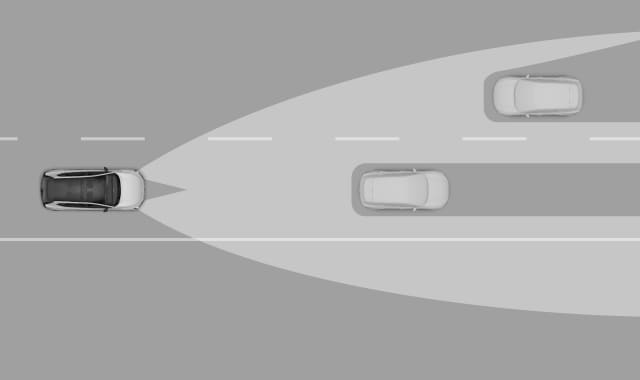
When enabled, the automatic high beam automatically adapts the beam pattern to surrounding traffic to avoid blinding other road users.
Note
Automatic high beam only activates at speeds over approximately 37 km/h (23 mph) and in low light.
 | Manual high beam is active. |
 | The automatic high beam is enabled but not active. |
 | The automatic high beam is active and the lights are turned on. |
Adaptive highway light
The adaptive highway light is part of the automatic high beam system. If you are driving at high speeds on the highway, the adaptive highway light adapts the beam pattern on the passenger side of the road to the surrounding traffic. The high beam on the driver's side automatically switches to passing beam if any traffic is detected.
Make sure that the vehicle cameras are well-maintained and kept clean. If the cameras’ views are obscured by dirt, they will not be able to obtain enough information to properly direct the vehicle’s lighting responses.Important
